Saturday, August 27, 2011

Tracking Candidate Rick Perry in 2012 News Pattern Radar


This week, candidate Rick Perry continued his strong advance in US national polling. The August 26, 2011 Wall Street Journal Political Diary, under the article of Perry on Top, reported these two polling results:

Gallup: "According to Gallup, Mr. Perry now leads the Republican presidential field with 29% of the vote. Mitt Romney, who was ahead up to this point, has fallen to 17% (he was at 23% in July and 27% in June), while Michele Bachmann has fallen to fourth place with just 10%. Ron Paul, meanwhile, took 13%."

PPP: "They put Mr. Perry at 33%, Mr. Romney at 20%, and Ms. Bachmann at 16%. All other candidates were in single digits."

These polling results correlate well with our 2012 News Pattern Radar that has been tracking candidate Perry among competitors and issues over many months and hundreds of thousands of news/blog articles. This News Radar snapshot tracks the Perry news topic as it danced around the radar periphery for many weeks while Romney led in the polls. Then around the middle of August at the Perry official announcement, the Perry topic vectored into the radar center, as a news pattern that indicated that Perry became more relevant than Romney and the entire 2012 GOP field.

rasmussen results

All during this period from June 1st, until August 26, 2011, the core 2012 news patterns of Conservative and Obama were quite consistent, indicating that the 2012 election is emerging as conservative ideas versus Obama. Also consistent were the high relevancies of Economy, Jobs and Spending topics, all highly connected to the Obama topic and the core of the 2012 radar.

If the Romney topic is to displace the Perry topic, and correspondingly regain leadership in the polls, Romney news patterns will need to better connect with Obama and the core topics, as a replacement for the Perry news topic.


See real-time version of 2012 radar at ...  http://www.newspatterns.com/show_radar.php?name=gop2012

Sunday, August 21, 2011


News Pattern 2012 Radar Predicts that Candidate Perry Will Soon Lead Presidential Polling

Earlier this week, we made the call that candidate Perry would soon lead the GOP pack in regard to 2012 presidential (primary) polling.  Almost simultaneously with our prediction, a Rasmussen poll announced these results:

GOP Primary: Perry 29%, Romney 18%, Bachmann 13%

These results were a pick-up of 11 % points for Perry; -4 % points for Romney; and -3 % points for Bachmann.

Our 2012 News Radar, also correlates well with the first, second, third, etc. positions of the candidates. 
rasmussen results

We made our prediction based on these observable news patterns:

* Perry news topic became the candidate topic closest to 2012 news radar center

* Perry topic was the candidate topic most connected to the Conservative topic in an election where the idea of Conservative is the primary opposing topic against the Obama topic.

* Perry topic displaced other candidate topics that were closer to the radar center (Romney topic)

* Perry topic generated the most and strongest connections among other 2012 candidate and issue topics.


These disruptive patterns have been forming over many weeks, and became dominating at the start of this week, in spite of Perry not participating in Iowa straw-polling, and much of national media buzz being about Bachmann winning the Iowa straw poll.


Chalk another one up to the power of discovering patterns from the swarm intelligence from thousands of news content creators.

See real-time version of 2012 radar at ...  http://www.newspatterns.com/show_radar.php?name=gop2012

Thursday, February 10, 2011

Flattened User Context – A Consequence of Powerful Google Search Utilities

In many of my recent meetings, I have pointed out that “Google has flattened the awareness environment of decision makers.” As a start, I intend to convey the idea that decision makers are now getting almost any information they seek by inputting simple keywords into a Google search. While Google delivered information borders on the miraculous, there are consequences.


One of the consequences that must be understood is that powerful search often leads to the stripping of context from a user’s understanding of the search results. Context, as used here, is the “the circumstances in which an event occurs; a setting.” Without context, sought after information is flat. This flat information does not have the personal associations, setting, history or circumstances as information in context.


Flattening the World

Think of information in context this way. It was not so long ago that a person would go to a library to seek out information. Along the way to finding target information, the seeker would be exposed to related publications that were not conceived at the onset of the search. The seeker might also be aided by a librarian who could further expand the depth of context about a topic. Even the fact, that the library was local to the seeker, increased the likelihood of useful context. The historical nature of the searching process was inherently rich in context. Today, any person can type a short string of words into a Google search box, even if incorrectly spelled, and Google will return highly relevant and prioritized results for the seeker. Nevertheless, the immediate gratification of instant search results without context will invariably flatten the seeker’s potential for understanding. [In response to the context issue, Google is making great strides to consider the search history or location of a user as clues for improved search results.]


I have many industry experiences that are also indicators of a flatter information world:

• Many of my junior clients do not even know the competitive topics for which they should be monitoring.

• Once individual search alerts are constructed, the vast majority of decision makers do not update the keyword criteria of these searches even though relevant topics are changing and the actual language itself of the topics are changing.

• The “siren song” of confirmation bias inclines users to only search for information that verifies what they already believe.

To further complement Google search results or any information source, News Patterns is creating dynamic “radar sectors” that create useful context around related topics. An example of related topics can be a political campaign, composed of competing candidates and the issues that are defining the election. Another example of related topics is a market environment among competing companies, products, customers, suppliers and technologies. News patterning algorithms first define the likely topics for useful context. Other patterning algorithms define how context is defined and shaped by new information. While other algorithms create visual representations of related topic context in which an information seeker can interact to search for target information as well as to discover information that was not initially the target information. An end benefit of news patterning context, is the extension of powerful Google searches complemented with individual user discovery of the unanticipated, yet important and relevant. The world can indeed be flattened and rounded at the same time.


Tuesday, September 7, 2010

News Patterns 2012 Radar Correlates With Alaska Polling Results for Likely Presidential Candidates

News Patterns has been operating an active intelligence network regarding possible Republican contenders for the 2012 US Presidential primary election. Every day thousands of news and blog articles are collected, filtered for noise, and searched for interesting connections and patterns. After billions of pattern matching calculations are completed, a News Radar is produced that represents connections and relationships among the news topics. In the case of the 2012 radar, the topics are potential 2012 contenders and the issues that may define them in a prospective campaign. As new news is collected and patterned, the News Radar moves and evolves to reflect the new data.

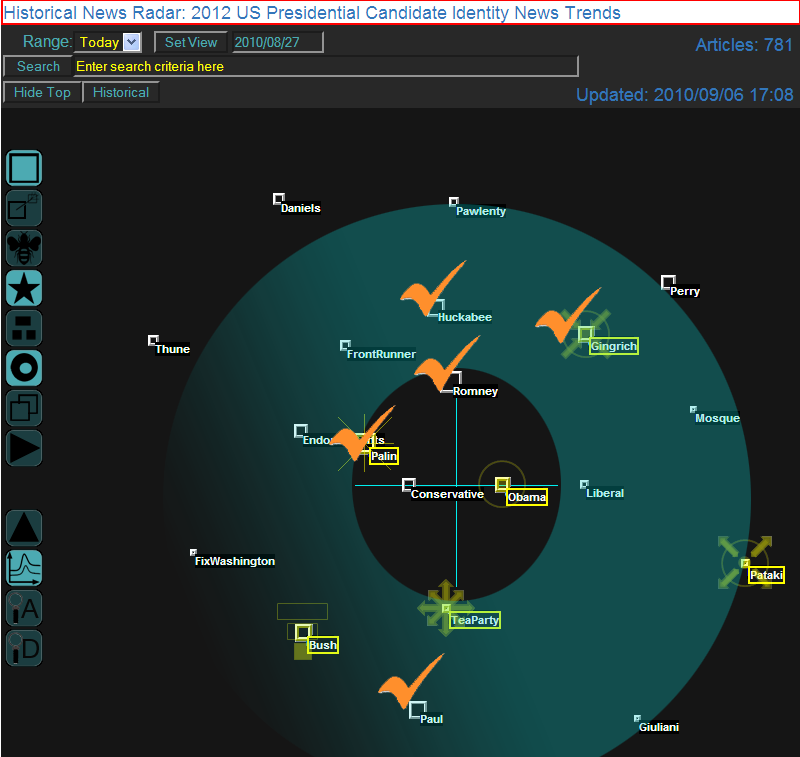
On August 28, 2010 the 2012 Presidential News Radar displayed that the top GOP contenders were Romney, Palin, Huckabee, Gingrich, Bush and Paul in this order. In the following image, one can see these top contenders clustered about the center of the 2012 News Radar. Additionally, the distance that a candidate is plotted from the radar center is typically inversely proportional to actual polling results. For example, in the displayed news radar as follows and in larger version here, the 2012 News Radar would indicate to us that Romney and Palin were the top contenders as measured by news patterning.

Small2012radar

Also on August 27 and 28, 2010, a poll of Alaska voters was taken, probing likely preferences for 2012 GOP candidates. The results were published in Politico and are as follows: Romney 20%, Palin 17%, Huckabee 17%, Gingrich 16% and Paul 10%. The results did not state if other candidates like Jeb Bush were also included in the poll.

The thing to notice in comparing the News Patterns results with the Alaska poll results are that they are remarkably similar in the list of the names and the order of those names. The polling method started with a forced list of names that were used to question Alaska voters. The News Patterns method started with thousands of news and blog articles that calculated into a primary list of 2012 candidates with some sense of priority. This is a good example where News Patterns algorithms can approximate other methods (polling) of determining the collective beliefs of groups of people.

Sunday, August 22, 2010

News Patterns Discovery 2: Searches Without You Needing to Type


In my previous blog, News Patterns Discovery - The Disciplined Enabling of Serendipity, I referenced a Wall Street Journal article. In this blog I will continue my reliance on the WSJ with an interview of Google CEO, Eric Schmidt. On Saturday (August 14, 2010) , the WSJ published this interview of CEO Eric Schmidt: Google and the Search for the Future conducted by Holman Jenkins. In the article, Schmidt had these things to say:

"...more and more searches are done on your behalf without you needing to type."

"I actually think most people don't want Google to answer their questions," he elaborates. "They want Google to tell them what they should be doing next."
:

These are two ideas captured by our existing News Patterns innovations.  :

* Our patterning and radars suggest interesting market events that are discovered with powerful algorithms.  Then with a single click, a user can access the desired articles that are retrieved with complex search logic.  The end result is that simple clicking results in potentially interesting or surprising articles that were not typed in as searches.  We call this process Discovery. News Patterns implements this type of "searches without you needing to type" in visual News Radar interfaces and discovery briefing email.   :

* Our algorithms also suggest what our users should look at first or "should be doing next" by first discovering patterns, then prioritizing many possible patterns to investigate.:

Beyond that sophisticated algorithms that enable the above innovations, News Patterns and Google are relying on a useful context for their users. In the above WSJ interview, Eric Schmidt uses the example of real-time proximity enabled by GPS phones, that might tie a user's needs with near locations of products or services that can satisfy those needs. In the situation of News Patterns, the context that we create regards potential market or political threats driven by rivers of news signals. By seeking relationships among many different competing factors, then alerting users when relationships might be changing or new relationships are emerging, News Patterns draws users attention to information areas that might be interpreted as threats or opportunities - without typing search terms!:

The net result is a faster and more timely provision of useful information to News Patterns users without them even knowing that they should be seeking the particular news articles.

Saturday, August 14, 2010

News Patterns Discovery - The Disciplined Enabling of Serendipity


On April 5, 2010 L. Gordon Crovits wrote this article in the Wall Street Journal: The Search for Serendipity. At the time that I read this article I was nodding in agreement with this particular passage in the article:

The challenge for modern information consumers becomes: How do you discover what you don't know you want to know?

Old-time print journalists bemoan the absence of serendipity—the accidental discovery of stories that readers didn't know they were interested in reading. In the words of a recent blog post at the Nieman Journalism's Lab site, "While there is more news on the web, our perspectives on the news are narrower because we only browse the sites we already agree with, or know we already like, or care about." With newspapers, by contrast, readers discover "things we didn't care about, or didn't agree with, in the physical act of turning the page."

Part of the reason that we browse that which we are comfortable is because we as humans have a very low input bandwidth when measuring the amount of information that we can input to our conscious minds by reading. In fact this reading input rate is in the range of 200 bits per second. Consider this 200 bits per second as glacially slow when considering that our minds input graphical information at the rate of 10,000,000 bits per second. There is little wonder why we soon fatigue when exposed to the huge volumes of text news information that are at the other ends of search queries and alerts. By returning to sites that we agree with, as stated by Nieman Journalism lab, we are actually employing a strategy of using scarce information input bandwidth. It takes far less energy to read something with which we agree, than information that challenges our beliefs.

In our News Patterns world, we enable greater serendipity by converting large volumes of news information into graphical patterns. It is the visual pattern that incites the interest of our users. By intention, some patterns look threatening, new, and unexpected. Once a pattern has earned the attention of our users, he/she can easily drill beneath the surface to the actual news articles defining the graphical pattern. Like scanning a news paper, News Patterns users scan large volumes of news data, quickly bypassing some information while focusing on others, all without a forced reading of too many individual article details.

With such a graphical scanning process supported by algorithmic patterning processes that discover patterns of probable interest to our users, we empower them to a superior situational awareness of the here and now, and enable them to transcend comfortable sources with discovery or serendipity.


Wednesday, July 7, 2010

Its All About the Billions of Computations, Patterning Algorithms and Alerting in News Patterns


Here is an interesting anecdote about the use of News Patterns as a market analysis and discovery tool. 

Each day, we collect 10,000 articles related to Wireless industry as part of our "sector chief" assist to our clients.  This figure does not even include social media inputs.  Obviously, one cannot read or even scan them all.  Nevertheless, the goal is to find trends or discover new combinations among competitors, customers, technologies, resources, regulations, etc.

In Wireless Application radar, we noticed a new combination that was outlined in yellow, signifying that the connection was new and not seen in recent history.  Using a 1 to 1 permutation calculation, there was a 1 in 800 chance that we would have attempted to make that specific connection, even if we had the patience to create the specific AND logic to search the combination.  (The 800 figure is derived from a starting point of 40 open folders/topics using the equation of n!/(2(n-2)!)

Upon clicking on the highlighted yellow connecting line between Windows Mobile (software) and HTC (handset manufacturer), our news analysis system surfaced a rumor that handset manufacturer HTC might be coming out with a Windows phone as rumored in the UK.  This market scenario was interesting to our team and will be tracked for further news patterns developments.


Its about the billions of computations, patterning algorithms and alerting in News Patterns that we could go from 10,000 articles and 800 combinations to an interesting discovery in seconds.