Sunday, April 7, 2013

Discovery is the Next Major Step of Awareness Beyond News Search

We are now entering the era where discovery is the next major step of awareness beyond search in our information economy.  Discovery enables a superior competitive awareness within a very small window of user/client attention.  The "routine" search for news and social media is transcended by real-time and actionable discoveries for individual decision makers.

Search has been the natural first step in Internet awareness.  Information utilities created massive databases of news, blogs, social media and tweets that were indexed for ease and speed of searching via keyword queries.  Search is easy and direct, and as time progressed, analytics became enhanced summaries of pre-loaded search queries for public relations and media monitoring dashboards - not in order to support decision makers & discovery.


News search is self limiting for decision makers:
  • Search could never enable surprises, as it presumes that the searcher already knows for what he/she is searching.
  • Decision makers do not know the scope/definition of what their interest universe should be.
  • PR and media monitoring, often the source for organizational news awareness, are not tasked to discover strategic competitive insights.
  • PR and media monitoring are often barriers to keeping unfavorable & important information from decision makers.
  • Superior competitive discoveries are found in a large universe of potentially interesting topics - too many for any one decision maker to track alone.
In a natural progression to solve the limitations of search, most Internet utilities are adopting discovery as part of their user value.   Google, Amazon, Facebook, Twitter, LinkedIN, Apple and QUALCOMM are recent examples of major efforts to deliver some form of discovery to users.  One definition of discovery is "unexpected" information not the result of specific searching.   My definition of discovery is this:

Discovery - the measured and prioritized alerting to targeted recipients of relevant "news" and trends pertaining to their intelligence interests. 

This definition also includes situations where recipients do not know their own interests or are not actively seeking information on those interests.  Some further clarifications are useful:
  • news - traditional real-time news articles, blogs, videos, audio, social media and tweets
  • trends - emerging or dissipating patterns that are relevant for competitive success
  • relevant - having a significant and demonstrable bearing for the matter at hand. Merriam Webster Dictionary
  • interests -  participation in advantage and responsibility. Merriam Webster Dictionary
  • intelligence - information pertaining to survival or competitive response
  • targeted - discovery based on individual identities
  • prioritized - highlighting in descending order of urgency or relevancy
  • measured - limited and in proportion to urgency and attention capacity of the receiver
  • alerting - interrupting the attention of the receiver in the minimal time required for a message to be delivered
From the perspective of our Discovery Patterns (aka News Patterns), we are transcending what can be searched from hundreds of millions of expert and community content creators.  We are furthermore transcending the incredible machine content from news database that enable ever more powerful searches and analytics of those searches.  With our unique pattern seeking algorithms, we are enabling our free network members and our private clients to discover relevant news and trends for which they could not or would not be searching.  Discovery enables a superior competitive awareness (situational awareness) within a very small window (bandwidth) of user/client attention.


Wednesday, April 3, 2013

Content Will Always Be King Among News Creators

News Patterns has been a pioneer in the realm of discovery for over eight years. In my next blog I will give a detailed description of discovery versus search. This blog post will first set the stage defining the different types of news content creators.
Expert and Community Content are obvious to most information professionals.  Simply stated, Expert Content is created by authors and organizations whose business is to professionally inform target audiences either as subscriptions or advertising driven business models.  Community Content is the socially driven content that creators write or record as part of relationships with other community members.

Machine Content is often not considered, but nonetheless invaluable in the news content universe.  Machine content essentially synthesizes new content with algorithms and database processes out of original content from Experts and Communities.  Here are some examples of machine content:
  • Search indices with built in relevancy  (made famous by Google and "page rank")
  • Aggregation pioneered by LexisNexis and Factiva
  • Low latency feeds that supply instant stock trading black boxes
  • Media monitoring dash boards that track public relations interests
  • News Patterns Discovery - algorithmic pattern seeking of trends or events of competitive interest  (More on this in next blog addition.)
The above venn diagram illustrates that there are many overlaps among the news content categories.  Here are some examples:
  • Expert journalists often search machine Google as part of researching articles.
  • Members of community Twitter often notify their followers of interesting expert articles.
  • Public relations professionals use their machine media monitoring dashboards of expert and community content to research their next press release.
  • Expert journalist use community Facebook as an alternative mode of article distribution.
  • Community LinkedIN redistributes expert articles in an attempt to increase site page views
  • etc.
I have several concluding thoughts:
  • Expert and Community content could operate as viable, and independent categories.
  • Machine Content is completely dependent on Expert and Community Content.
  • Simple forms of machine content (as in better searches and monitoring analytics) can easily be adopted by expert and community content creators; whereas the reverse of expert or community content cannot be readily created by the machine content category.  Therefore for machine content creators to maintain their market viability, they must be increasingly innovative in the user value that they add to the "content is king" news universe.


Update: Risk Topics Under the Surface of Financial Meltdown Radar

Earlier this year (February 5th of 2013) I wrote that our news patterning process had discovered the threat topics of Capital Controls and Bank Runs. With the recent events in Europe - Cyprus more specifically - our financial meltdown radar continues to track the growing disruption of these two threatening topics to world financial stability.

The swarm intelligence of thousands of news content creators, as discovered by our news patterning algorithms, saw these threats coming long before Cyprus became a news headline.

Tuesday, February 5, 2013

Risk Topics Under the Surface of Financial Meltdown Radar

News Patterns has been creating News Radars for many years. A News Radar is an animated visual system for representing competitive patterns among market players. These market players can be competitors, suppliers, buyers, government actions, societal trends, etc. A very complex radar like Financial Meltdown can be composed of 30,000 news and blog articles per week.

Back in 2009, we were often asked if our radars saw interesting patterns that might have foretold of the pending financial meltdown initiated by unwise real estate lending. The short answer is no. We were not aiming our radars at financial markets at that time.

Now in 2013, we are aiming at our radars at world wide financial markets. We call this radar Financial Meltdown.


Beyond the obvious topics of Recession, Recovery, Debt, Deficits, Unemployment, etc, this radar is tracking some very interesting topics that will serve as an early warning of financial system risks:
  • Bank runs
  • Capital controls
  • Nationalization
  • Seizure of retirement accounts
  • Hyper-inflation
  • Hoarding
  • Bartering
  • Debt downgrading (especially US Treasuries... ouch!)
  • Gold and precious metal prices/accumulation
  • Transfer of sovereign gold from US depositories
  • Commodity prices
  • Rationing
  • Austerity
  • Unrest (rioting, protests, etc.)
These tracked topics will seldom be front page news or conversation topics in television talk shows.  Nevertheless, all of the above have emerged to some degree over the past year.  Seekers of financial risks now have a powerful tool in our Financial Meltdown radar to discover risk trends that might be lost in the "fog of news."


Sunday, November 11, 2012

Candidate Romney Won the Battle but Lost the War for Presidential Election News Patterns

News Patterns has been tracking and patterning the news of the 2012 US presidential election for several years. Millions of articles were collected and subjected to our pattern discovery algorithms. A very powerful aspect of our news patterning is that patterns in the news often anticipate or closely correlate to actual voter behaviors. This past Tuesday, all the patterning came down to the actual voting. Here is what we saw and would have recommended to both Romney and Obama campaigns:

1) The 2012 News Radar correctly displayed that the election was about Obama versus Romney, showing both of these news topics as central and anchors in News Radar.


2) Romney campaign succeeded in making the logical topics of Economy and Jobs as central election topics. Nevertheless, the Obama campaign trumped this campaign battle success with its own news topics.

3) The Obama campaign was successful in creating the emotional "war on women" as a central campaign topic.

4) Super storm Sandy gave millions of voters an opportunity to see Obama as the leader in times of need and citizen support.  Governor Chris Christie made this a super topic by reinforcing bipartisan imagery with Obama just before the election.

5) Obama campaign gathered additional support with Education and Fix Washington topics.  Romney campaign contested the Fix Washington topic.

6) Romney used Spending as one of his campaign topics, yet Obama team muted this topic with associations of "do nothing Congress."

7) It was a great surprise to News Patterns analysis team that Romney campaign did not make better use of Fuel Cost and Food Cost topics, both of which were essentially irrelevant on election day.

8) The Health Care-Tax topic, created by the Supreme Court was also not used by the Romney campaign.

9) It is also surprising that Team Romney did not use Security/Arab Spring topics to their advantage.

If there was a meta pattern that points to the Obama success in the 2012 election is was this: the hard facts of Economy and Jobs as targeted by team Romney were trumped by US electorate wanting emotional comfort, including the idea that their choice from 2008 was a good man and leader.  To the undecided, still on the fence in the previous week, the imagery of Obama the leader in time of crisis over Hurricane Sandy swayed them in the direction of Obama.  There was no time for a Romney recovery.  The Romney campaign never built up a reservoir of emotional attraction to Romney the man and leader, nor an emotional distaste for Obama the man and leader.


Monday, July 16, 2012

Past, Present and Anticipated Future of Ultrabooks in Competitive Tablet Ecosystem

According to a Wikipedia reference, Ultrabooks are higher-end types of subnotebooks defined by Intel. As such, these devices are natural competitors for tablet devices, in particular the Apple iPad and various Android and Windows devices. Ultrabook devices have been tracked in the Tablet Ecosystem News Radar since the start of 2012. One of the objectives of news pattern tracking is to determine if a new technology (in this case Ultrabooks) challenges existing competitors and therefore disrupts a marketplace. There is no doubt that Intel and Ultrabook device manufacturers are setting a goal to disrupt the marketplace and to take device market share away from Apple iPads and other tablet devices.   If this disruption occurs, our News Radars will highlight the market interactions and call out relevant articles that chronicle the market changes.

Another objective of News Patterns members is to better anticipate the future.  With a superior real time situational awareness of market/political events, News Patterns members often leverage patterns in the news to discover market trends that can be pushed into the future.  Some of these trends might correlate with actual market measures like sales, shipments, polling or election results. 

The Six Month Past
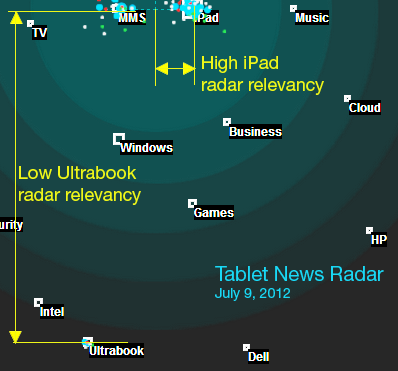
On January 2, 2012, iPad news patterns exhibited a high degree of competitive relevancy, with the iPad topic plotted very near the center of the Tablet News Radar.  At this same time, the Ultrabook topic was plotted near the periphery of the Tablet News Radar, an indication of low news pattern relevancy.


The Present or One Week Past
Now roll the tapes forward to one week ago, July 9, 2012.  From the following image one can see that Apple iPad continued to be highly relevant in the Tablet News Radar while Ultrabooks continued to be of low relevancy.


I chose the date of July 9, 2012 because it was on this day that Robert Powell of the Wall Street Journal Marketwatch published this article about News Patterns: Mining the news for patterns investors can tap - News Patterns’ data can help investors see relevant trends.  As part of this article, the low relevancy of Ultrabooks in the Tablet News Radar was highlighted. In our algorithm development, we often find strong correlations between news pattern relevancy and actual market/election performance. Better yet, our patterns often anticipate market/election trends, just as Powell described in his article.

Three days after the Powell Marketwatch article, check out this article that correlates/anticipates our patterns with actual market performance: Ultrabooks flop in Q2, PC market implodes as Apple wins in the U.S. (Boy Genius Report) 2012-07-12 08:46   
Market research firm Gartner paints a grim picture of the PC market in the second quarter this year as shipments dropped more than 5% in the United States and stayed flat globally. HP remained the world's top PC vendor worldwide as shipments of HP desktops and laptops slid 12.1% to 13.04 million, and chief U.S. rival Dell dropped 11.5% to ship 9.35 million units. Asian vendors Lenovo, Acer and ASUS each showed growth during the...

The Powell article in conjunction with Boy Genius article created timely data points about News Radar insights, correlating and anticipating radar positions with actual market performances.  (Note, this example is not an absolute about similar market correlations.  No past news patterns can guarantee future market/election correlations.)


The Three Month Future
In spite of the Ultrabook's 2012 history of low Tablet News Radar relevancy, we as News Patterns have made this Pattern Prediction on July 12, 2012:

Pattern Prediction: Intel and Ultrabook topics will double their tablet ecosystem relevancy by end of October 2012 by building strong connections to MMS topic (movies, media, video, streaming.)

Intel has a strategic interest in the tablet/"Ultrabook" ecosystem.  It will play to win.  This pattern prediction is now a human estimate based on the technical and market power of Intel. In the not too distant future, perhaps even this pattern prediction can be algorithmically driven. If this pattern displays itself, the Ultrabook topic will move toward center of the Tablet News Radar, disrupting the pattern position of iPad, Android and Windows tablet devices. Time and radar movements will tell if this pattern comes true. The power is that we can watch for these patterns day by day in a superior situational awareness interface.  I will report over the next several months about the accuracy of this Pattern Prediction.


Wednesday, June 20, 2012

Clash of Tablet Titans Plays Out In Video Game Like Interface of News Patterns

Our News Patterns algorithms take in huge volumes of news and social media to create animated visualizations of competitive situations in business, finance, politics and societal security.  Over time, the most relevant companies, ideas, products, and candidates win and hold a center position in our News Radars.  Patterns in our radar visualizations induce our member/users to interact with our visualizations and to click-through the patterns to discover the actual relevant news articles.


Presently, our patterns are watching the clash of major technology companies in the tablet ecosystem.  The Apple iPad has been the clear news pattern leader, which has directly correlated with Apple's sales and market dominance.  Yet, other technology companies want a piece of the Apple iPad action.   Check out our recent "video game" interface of 10,000 weekly news and blog signals about the tablet ecosystem.  Public Tablet News Radar Link


So far this week...
  • Microsoft introduces its Surface tablet, inducing a disruptive movement toward tablet radar center and iPad. "P"  Microsoft is displayed as Windows above. 
  • Google responds with buzz about its planned Nexus tablet. "S1"
  • Disruptive movement of Windows (as in Microsoft Surface tablet) has a positive effect on Intel and Ultrabook. "S2"
Note, not all introductions are disruptive.  Most fail to gain any competitive relevancy.

Over the next several weeks, competitive patterns will play out, determining whether Microsoft/Windows will sustain its challenge to Apple/iPad, and whether Google Nexus/Android will continue to be the number two competitor to Apple iPad.