Wednesday, June 20, 2012

Clash of Tablet Titans Plays Out In Video Game Like Interface of News Patterns

Our News Patterns algorithms take in huge volumes of news and social media to create animated visualizations of competitive situations in business, finance, politics and societal security.  Over time, the most relevant companies, ideas, products, and candidates win and hold a center position in our News Radars.  Patterns in our radar visualizations induce our member/users to interact with our visualizations and to click-through the patterns to discover the actual relevant news articles.


Presently, our patterns are watching the clash of major technology companies in the tablet ecosystem.  The Apple iPad has been the clear news pattern leader, which has directly correlated with Apple's sales and market dominance.  Yet, other technology companies want a piece of the Apple iPad action.   Check out our recent "video game" interface of 10,000 weekly news and blog signals about the tablet ecosystem.  Public Tablet News Radar Link


So far this week...
  • Microsoft introduces its Surface tablet, inducing a disruptive movement toward tablet radar center and iPad. "P"  Microsoft is displayed as Windows above. 
  • Google responds with buzz about its planned Nexus tablet. "S1"
  • Disruptive movement of Windows (as in Microsoft Surface tablet) has a positive effect on Intel and Ultrabook. "S2"
Note, not all introductions are disruptive.  Most fail to gain any competitive relevancy.

Over the next several weeks, competitive patterns will play out, determining whether Microsoft/Windows will sustain its challenge to Apple/iPad, and whether Google Nexus/Android will continue to be the number two competitor to Apple iPad.


Sunday, May 27, 2012

The World's First Video Game Interface for News & Social Media Alerts

Always an engineer at heart, I have always been inspired by the addition of useful visual imagery as part of decision support and analysis.  In fact I started my career with Structural Dynamics Research Corporation (SDRC) as a co-op student using advanced dynamic visualization of vibrating structures as part of engineering designs.  SDRC was a leader in what we now call CAD or computer assisted design. Today, in the era of BIG DATA, it is an imperative to integrate visualizations into decisions that cannot be accomplished with text readouts alone.  News Patterns (aka Netro City Design) was founded on this vision of visualizations and decision support.

As our developments in visualizations grew, it became obvious that the CAD metaphor for news insights was insufficient.  For example, CAD solutions do not necessarily take into account the real-time and dynamic nature of changing situations found in competitive news patterns.  A metaphor more dynamic and interactive was required.  And that metaphor was the Video Game.


The logical foundation of detecting news based competitive patterns with a video game interface starts with these simple ideas:
  • Faster- Our brains perceive patterns at 10,000,000 bits/second versus we read at only 200 bits/sec.
  • Superior Insights- Movements can highlight important alerts and emerging trends.
  • Intriguing- Videos, animations  and interactions earn attention that static displays cannot.  (Especially next generation members.)
  • Winning- News Pattern network members read news to be better competitors.  Video game interface reinforces the idea of competitive advantage.
Members of News Patterns read news to win in their business, political, financial or societal security jobs.  There are always competitive forces that hinder their successes. Nevertheless, with the greater visibility of competitive patterns based on real-time news, our members can see more and react more quickly by interacting with our News Radar interfaces as they would play a video game.


Wednesday, May 2, 2012

A Collective Wisdom Lives in the Seeming Chaos of News

I had the opportunity to discuss the trends that one can discover with our News Patterns algorithms and visualizations.  I was talking with a group of sophisticated managers from the financial services industry.  It was not long before I realized that they were very skeptical that any useful patterns could be derived from the data we call news.  (News in this blog can include traditional news, message boards, blogs, RSS feeds, Google Alerts, videos, social media and Twitter.)  They were convinced that news was mostly biased and dominated by ignorant contributors, or Garbage In = Garbage Out.

Swarm Trends

In answering their skepticism, I started by referred to a 2004 book by James Surowiecki called The Wisdom of Crowds - Why the Many Are Smarter than the Few and How Collective Wisdom Shapes Business, Economics, Societies and Nations.  At the time of publication, James Surowiecki was a staff writer at the New Yorker, with other publications including the New York Times, the Wall Street Journal, Artforum, Wired and Slate.  I started my explanations with two references from the "Wisdom of Crowds."
  • In 1884, at the International Exhibition in London, a British scientist named Francis Galton collected all the individual entries for a weight judging contest of a slaughtered and dressed ox.  Eight hundred contestants of various abilities entered the contest.  "Galton undoubtedly thought that the average guess of the group would be way off the mark.  After all, mix a very few smart people with some mediocre people and a lot of dumb people, and it seems likely you'd end up with a dumb answer.  But Galton was wrong. The crowd had guessed that the ox, after it had been slaughtered and dressed would weigh 1,197 pounds."  The actual weight was 1,198 pounds, or an error or 0.08%!
  • John Craven was a naval officer who was tasked to locate the U.S. submarine Scorpion that sank in the Atlantic Ocean in 1968.  Craven assembled a team of various experts who were to independently offer sinking and location scenarios without consulting with each other.  Craven compiled the individual scenarios and with some calculations, determined the "collective" location of the submarine.  This location was unique from any individual guess.  The "collective" location was 220 yards from the actual location.
The point that Surowiecki was making is that there is a collective wisdom among groups of humans, even though nobody can point to a central coordination of this wisdom.   Here is an example of the  collective wisdom of news creators from my experience at News Patterns that supports the ideas of James Surowiecki:
  • In 2009, Nokia had continued its dominance of the cell phone and smart phones markets, often kissing a 40% share of handset sales.  Yet starting in the Fall of 2009, two new competitors entered the smart-phone market.  The first was Apple with its iPhone.  The second was not really a distinct competitor but a new competing operating system from Google called Android.  We at News Patterns collected and patterned hundreds of thousands of articles with special algorithms over many months.  The collective wisdom of thousands of news creators soon discovered that iPhone and Android displaced Nokia, causing Nokia to fall from a central market relevancy to a peripheral relevancy position by November of 2009.  A competitive fall from news pattern relevancy often correlates with an actual decline in market or campaign relevancy. In November of 2009, a significant divergence of stock price versus news pattern relevancy occurred.  This drop in competitive news pattern relevancy was not noticed by the stock market.  In April of 2010, Nokia announced that it was falling far short of market expectations with its smart-phones due to competition from iPhone and Android.  In a short period of time in April, Nokia's stock price dropped 52%, a move that started to realign Nokia's stock price with the competitive news pattern relevancy (or irrelevancy) of Nokia among its competitors.  The collective wisdom of thousands of news creators, as part of a mass of 200,000 plus articles over 5 months was a front-runner to the new competitive pressures on Nokia.
Of course there are no absolutes in the value of discovered news patterns.  Sometimes a news reporting community is too small.  Sometimes, it is possible to "fool all of the people some of the time."  Yet with modern collection and computation processes, it is possible for news to be a source of a greater collective wisdom, not seen by any participaing member of the collective.

See more details about the collective wisdom of news creators in this paper: Anticipating Financial Market Moves Using Long Term Patterns in the News .

Monday, April 23, 2012

Facebook's Potential Search Power Will Not Surpass Google's

On April 22, 2012, Diane Mermigas wrote this article in Business Insider: Facebook's Potential Search Power Could Surpass Google's.  The gist of the article is that the rich human interaction within Facebook is a superior method of creating invaluable context about Facebook members and their friends, thereby enabling a superior matching of advertising content and search results with individual Facebook members.  This could very well be true - to a point.  And that point is the line where sharing and updates crosses over to become spam for the notified Facebook members.  It is my observation that younger Facebook users and some demographic groups have higher tolerances for sharing based on extended periods of time for Facebook application usage.

But my analysis here pertains to professionals in business, finance, politics and societal security.  While all of these types of people may have Facebook identities, it is highly improbable that they are substantially sharing, liking, or friending within the external communities where they compete and earn their livings.  Sure, there are exceptions like Realtors and insurance agents where selling is dependent on personal relationships.  Yet few in competitive environments are willing to reveal context about themselves that could expose personal weaknesses.  Few were also willing to offer any reason for a potential customer or voter to choose a competitor. 
Community and Context

Over ten years ago, we envisioned a news intelligence system that was augmented by collaborative insights.  We called this collaborative insight our "swarm index," named after the swarm intelligence found in colonies of bees.  Our swarm index enabled commenting, sharing, and changing of news article urgencies.  We also implemented powerful versions of "liking" that included measures of group threats or opportunities, far before Facebook.  In spite of all these community capabilities, it did not take us long to realize the true needs and behaviors of professionals in private networks to whom we targeted our news intelligence networks:
  • Our network members dedicated minimal time to collaboration or sharing.  They were just too busy to add more work to their daily schedules.
  • Our network members were concerned that if they were perceived to be uber collaborators, then they might correspondingly be perceived to have too much time on their hands.
  • People were concerned to offer collaboration content that might appear trite or untimely to their organization peers - and even worse to offer opinions that were contrary to shared organization beliefs.
All of these issues were solvable.  Our solutions rested on the foundations of low member collaboration expectations and smarter context algorithms - the general approach of Google. 

Looking ahead, it is understandable that Google is seeking more dedicated collaborative or community inputs that will help improve the context of its searching and advertising.  And it is expected that Facebook will continue to leverage its community contributed content and context.  Nevertheless, not all Internet users are potential Facebook content editors.  Many professionals (as in the 150,000,000 Linkedin members) will continue to rely in the intelligence of Google, and not risk the downsides of self contributed Facebook content.

Thursday, April 19, 2012

World Financial Meltdown Threat Patterns #1: An Unhealthy Calm

Just after the US financial crisis in the latter part of 2008, I was having dinner with a friend who had lost major parts of his retirement savings. He was not your expert investor. Rather he was a smart professional who trusted the advice of his financial advisor. It was obvious that his advisor did not see the coming storm in mortgage backed securities and the deleterious effect that this storm would have on the entire financial market. My friend was trusting what supposed experts were seeing.  At that dinner, I asked myself the question: "Why not enable ordinary people to see more of what is important around themselves - especially significant risks?"

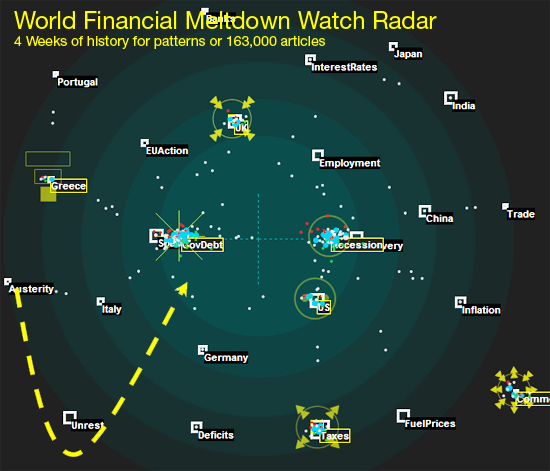
Like 2008, significant risks are brewing in world financial markets.  The following News Radar is a pattern discovery and tracking system based on tens of  thousands of daily worldwide news and blog articles.  In particular, the patterns that it seeks are patterns that portend potential threats or opportunities in world financial markets.  Over the past five or more years, we have discovered that seemingly chaotic and overwhelming flows of news contain a collective intelligence from thousands of news content creators.  These news makers, both professional and novice, tend to write about what is important or interesting to themselves.  When we add all their ideas together, an overarching intelligence, or swarm intelligence, can appear.

This World Financial Meltdown Watch Radar was plotted on April 18, 2012, and it contains over 160,000 news and blog articles from the previous four weeks.  One can see an active version of this radar at http://www.newspatterns.com/show_radar.php?name=financial2.  (Note that radar changes day by day with new news signals, and your browser will need to be compatible with HTML 5 to see this animation.)

Financial Meltdown Radar 2

The simple explanation of this radar is that the most relevant ecosystem topics are drawn to the center of the radar space.  In this case, the radar center is occupied by Spain and Government Debt (center left) and Recession-Recovery (center right.)  Today, this radar is reflecting the market anxiety about the recent Spanish government debt offering as well as the uncertainty whether the world is heading toward recovery or recession.

There are many other interesting patterns to dissect, yet I would like to get back to my "Unhealthy Calm" threat pattern.  It is my hypothesis that world financial markets cannot get back to viability until governments start to significantly curtail pension and entitlement benefits for their citizens.  Governments cannot continue to live beyond their means.  Higher taxes are not the solution.  Super robust economic growth is also unrealistic.

If governments do start down the path of entitlement and pension reductions (also known as austerity) then I expect that there will be significant unrest in effected populations.  Think of Greece, Spain and Madison, Wisconsin.  The above News Radar will reflect this pattern with a coupling of the Austerity topic with Unrest, which will further display as a movement of both topics toward the center of the radar.

The fact that there is so little implementation of austerity by world governments, tells me that world leaders are "kicking the can down the road", and not really addressing the heart of what ails world financial markets.  Ironically, massive societal unrest will be a healthy indicator that world governments are addressing their debt problems.

This calm of needed solutions is a significant threat that more need to see and track.  The longer that Austerity and Unrest remain as peripheral topics in the financial radar, the more world financial risks will grow.
 

Sunday, April 8, 2012

Looking at Context in the Context of News Patterns

We here at News Patterns often think about context as we develop our patterning algorithms and interfaces. According to the Merriam Webster definition...

Context: the interrelated conditions in which something exists or occurs; environment or setting.

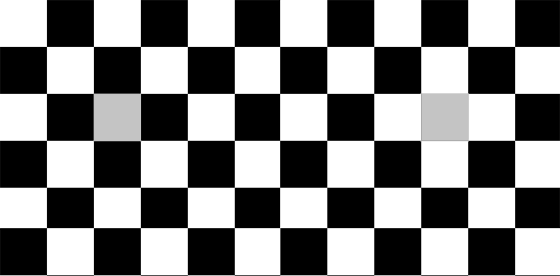
We extend the definition of context to include relevant relationships that enable one to see things differently as a result of those visible or conscious relationships. This graphic illustrates the point about the power of context:

Context Example

  
As one might suspect, both gray squares are actually the same color and lightness. Nevertheless, the gray square surrounded by black squares (left) appears to be darker than the gray square surrounded by white squares (right).  This visual perception shift is a result of the way our brains perceive patterns in light and dark fields.  We interpret the gray squares differently because of the the different contexts where they appear.

This same shifts in perception occurs when we are exposed to news signals based on these examples of news context from traditional news sources:
  • The credibility of the news article source (history of relevant coverage and factual accuracy)
  • The historical sentiment of the source (as in friend, foe or credible objective)
  • The relevancy of the news as it pertains to current needed information
  • The frequency of new story repetitions among different news sources

With our news patterning algorithms and animations, we extend the boundaries of context with these attributes:
  • Thousands of potential relevant sources
  • Extended periods of time (days, weeks, months and years)
  • Topics that should be tracked as part of important interests
  • News that correlates with archetypical patterns of competition
  •  New topics that are deserving of active tracking
  • Visual animations of context and trends
  • Tracking layers set to anticipate actual market, political or societal events
  • Trusted group memberships that share news and relevancies of news articles

Since all this extra context would produce an overload of text if it were all in written form, News Patterns uses image and animation layers to add context to relevent news for our network members.  Context in image form is interpreted by humans at amazing speeds.  The end result is greater insight (as in more useful context) in a shorter period of time.

I will add more on this topic in a future post.  See also my most recent  post: Animation Innovations for News Patterns Radar Interfaces )


Sunday, April 1, 2012

Animation Innovations for News Patterns Radar Interfaces

In early February of this year, we added new animation layers to our News Radar interfaces. These animations were written in HTML5 so that they could be displayed across the widest range of Internet devices. We had three primary objectives:
* Connect the narrative of "swarm intelligence" with our radar visualizations
* Use movement to guide users to the most potentially relevant news and patterns
* Continue our progression to a video game like interface

The following image is a snap-shot of one of our animated News Radars.  Because this is a static blog page, movements are not active. Nevertheless, an active version of this News Radar can be seen at this location: Example Animated News Radar: Tablet Ecosystem
News Radar Example


Since each News Radar can represent thousands of news articles, the addition of moving objects captures the feeling that the radar is composed of many of these articles. The nature of the movements draws attention to highly relevant competitive topics and important connections among topics. As the volume and intensity of object movements increase, so too does the probability that these topics and connections deserve more attention.

And once desired attention is focused on these movements, News Pattern members/clients can "play" the interface with instantaneous drill-downs to the actual news and social media that might be most relevant for reading. This ability to play the news interface enables an extremely fast process for gaining high level overviews of a competitive environment while focusing on the most relevant news.