Monday, April 23, 2012

Facebook's Potential Search Power Will Not Surpass Google's

On April 22, 2012, Diane Mermigas wrote this article in Business Insider: Facebook's Potential Search Power Could Surpass Google's.  The gist of the article is that the rich human interaction within Facebook is a superior method of creating invaluable context about Facebook members and their friends, thereby enabling a superior matching of advertising content and search results with individual Facebook members.  This could very well be true - to a point.  And that point is the line where sharing and updates crosses over to become spam for the notified Facebook members.  It is my observation that younger Facebook users and some demographic groups have higher tolerances for sharing based on extended periods of time for Facebook application usage.

But my analysis here pertains to professionals in business, finance, politics and societal security.  While all of these types of people may have Facebook identities, it is highly improbable that they are substantially sharing, liking, or friending within the external communities where they compete and earn their livings.  Sure, there are exceptions like Realtors and insurance agents where selling is dependent on personal relationships.  Yet few in competitive environments are willing to reveal context about themselves that could expose personal weaknesses.  Few were also willing to offer any reason for a potential customer or voter to choose a competitor. 
Community and Context

Over ten years ago, we envisioned a news intelligence system that was augmented by collaborative insights.  We called this collaborative insight our "swarm index," named after the swarm intelligence found in colonies of bees.  Our swarm index enabled commenting, sharing, and changing of news article urgencies.  We also implemented powerful versions of "liking" that included measures of group threats or opportunities, far before Facebook.  In spite of all these community capabilities, it did not take us long to realize the true needs and behaviors of professionals in private networks to whom we targeted our news intelligence networks:
  • Our network members dedicated minimal time to collaboration or sharing.  They were just too busy to add more work to their daily schedules.
  • Our network members were concerned that if they were perceived to be uber collaborators, then they might correspondingly be perceived to have too much time on their hands.
  • People were concerned to offer collaboration content that might appear trite or untimely to their organization peers - and even worse to offer opinions that were contrary to shared organization beliefs.
All of these issues were solvable.  Our solutions rested on the foundations of low member collaboration expectations and smarter context algorithms - the general approach of Google. 

Looking ahead, it is understandable that Google is seeking more dedicated collaborative or community inputs that will help improve the context of its searching and advertising.  And it is expected that Facebook will continue to leverage its community contributed content and context.  Nevertheless, not all Internet users are potential Facebook content editors.  Many professionals (as in the 150,000,000 Linkedin members) will continue to rely in the intelligence of Google, and not risk the downsides of self contributed Facebook content.

Thursday, April 19, 2012

World Financial Meltdown Threat Patterns #1: An Unhealthy Calm

Just after the US financial crisis in the latter part of 2008, I was having dinner with a friend who had lost major parts of his retirement savings. He was not your expert investor. Rather he was a smart professional who trusted the advice of his financial advisor. It was obvious that his advisor did not see the coming storm in mortgage backed securities and the deleterious effect that this storm would have on the entire financial market. My friend was trusting what supposed experts were seeing.  At that dinner, I asked myself the question: "Why not enable ordinary people to see more of what is important around themselves - especially significant risks?"

Like 2008, significant risks are brewing in world financial markets.  The following News Radar is a pattern discovery and tracking system based on tens of  thousands of daily worldwide news and blog articles.  In particular, the patterns that it seeks are patterns that portend potential threats or opportunities in world financial markets.  Over the past five or more years, we have discovered that seemingly chaotic and overwhelming flows of news contain a collective intelligence from thousands of news content creators.  These news makers, both professional and novice, tend to write about what is important or interesting to themselves.  When we add all their ideas together, an overarching intelligence, or swarm intelligence, can appear.

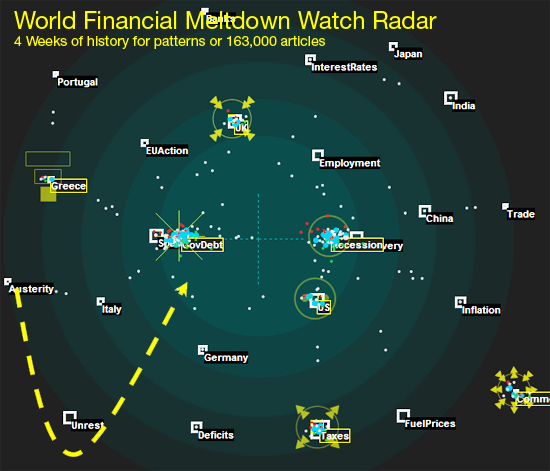
This World Financial Meltdown Watch Radar was plotted on April 18, 2012, and it contains over 160,000 news and blog articles from the previous four weeks.  One can see an active version of this radar at http://www.newspatterns.com/show_radar.php?name=financial2.  (Note that radar changes day by day with new news signals, and your browser will need to be compatible with HTML 5 to see this animation.)

Financial Meltdown Radar 2

The simple explanation of this radar is that the most relevant ecosystem topics are drawn to the center of the radar space.  In this case, the radar center is occupied by Spain and Government Debt (center left) and Recession-Recovery (center right.)  Today, this radar is reflecting the market anxiety about the recent Spanish government debt offering as well as the uncertainty whether the world is heading toward recovery or recession.

There are many other interesting patterns to dissect, yet I would like to get back to my "Unhealthy Calm" threat pattern.  It is my hypothesis that world financial markets cannot get back to viability until governments start to significantly curtail pension and entitlement benefits for their citizens.  Governments cannot continue to live beyond their means.  Higher taxes are not the solution.  Super robust economic growth is also unrealistic.

If governments do start down the path of entitlement and pension reductions (also known as austerity) then I expect that there will be significant unrest in effected populations.  Think of Greece, Spain and Madison, Wisconsin.  The above News Radar will reflect this pattern with a coupling of the Austerity topic with Unrest, which will further display as a movement of both topics toward the center of the radar.

The fact that there is so little implementation of austerity by world governments, tells me that world leaders are "kicking the can down the road", and not really addressing the heart of what ails world financial markets.  Ironically, massive societal unrest will be a healthy indicator that world governments are addressing their debt problems.

This calm of needed solutions is a significant threat that more need to see and track.  The longer that Austerity and Unrest remain as peripheral topics in the financial radar, the more world financial risks will grow.
 

Sunday, April 8, 2012

Looking at Context in the Context of News Patterns

We here at News Patterns often think about context as we develop our patterning algorithms and interfaces. According to the Merriam Webster definition...

Context: the interrelated conditions in which something exists or occurs; environment or setting.

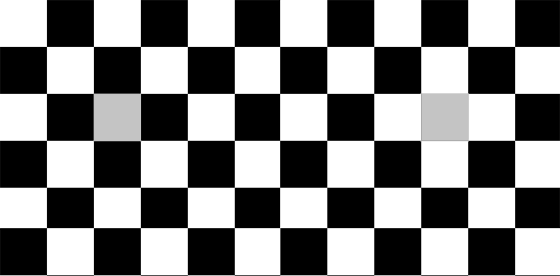
We extend the definition of context to include relevant relationships that enable one to see things differently as a result of those visible or conscious relationships. This graphic illustrates the point about the power of context:

Context Example

  
As one might suspect, both gray squares are actually the same color and lightness. Nevertheless, the gray square surrounded by black squares (left) appears to be darker than the gray square surrounded by white squares (right).  This visual perception shift is a result of the way our brains perceive patterns in light and dark fields.  We interpret the gray squares differently because of the the different contexts where they appear.

This same shifts in perception occurs when we are exposed to news signals based on these examples of news context from traditional news sources:
  • The credibility of the news article source (history of relevant coverage and factual accuracy)
  • The historical sentiment of the source (as in friend, foe or credible objective)
  • The relevancy of the news as it pertains to current needed information
  • The frequency of new story repetitions among different news sources

With our news patterning algorithms and animations, we extend the boundaries of context with these attributes:
  • Thousands of potential relevant sources
  • Extended periods of time (days, weeks, months and years)
  • Topics that should be tracked as part of important interests
  • News that correlates with archetypical patterns of competition
  •  New topics that are deserving of active tracking
  • Visual animations of context and trends
  • Tracking layers set to anticipate actual market, political or societal events
  • Trusted group memberships that share news and relevancies of news articles

Since all this extra context would produce an overload of text if it were all in written form, News Patterns uses image and animation layers to add context to relevent news for our network members.  Context in image form is interpreted by humans at amazing speeds.  The end result is greater insight (as in more useful context) in a shorter period of time.

I will add more on this topic in a future post.  See also my most recent  post: Animation Innovations for News Patterns Radar Interfaces )


Sunday, April 1, 2012

Animation Innovations for News Patterns Radar Interfaces

In early February of this year, we added new animation layers to our News Radar interfaces. These animations were written in HTML5 so that they could be displayed across the widest range of Internet devices. We had three primary objectives:
* Connect the narrative of "swarm intelligence" with our radar visualizations
* Use movement to guide users to the most potentially relevant news and patterns
* Continue our progression to a video game like interface

The following image is a snap-shot of one of our animated News Radars.  Because this is a static blog page, movements are not active. Nevertheless, an active version of this News Radar can be seen at this location: Example Animated News Radar: Tablet Ecosystem
News Radar Example


Since each News Radar can represent thousands of news articles, the addition of moving objects captures the feeling that the radar is composed of many of these articles. The nature of the movements draws attention to highly relevant competitive topics and important connections among topics. As the volume and intensity of object movements increase, so too does the probability that these topics and connections deserve more attention.

And once desired attention is focused on these movements, News Pattern members/clients can "play" the interface with instantaneous drill-downs to the actual news and social media that might be most relevant for reading. This ability to play the news interface enables an extremely fast process for gaining high level overviews of a competitive environment while focusing on the most relevant news.

Saturday, August 27, 2011

Tracking Candidate Rick Perry in 2012 News Pattern Radar


This week, candidate Rick Perry continued his strong advance in US national polling. The August 26, 2011 Wall Street Journal Political Diary, under the article of Perry on Top, reported these two polling results:

Gallup: "According to Gallup, Mr. Perry now leads the Republican presidential field with 29% of the vote. Mitt Romney, who was ahead up to this point, has fallen to 17% (he was at 23% in July and 27% in June), while Michele Bachmann has fallen to fourth place with just 10%. Ron Paul, meanwhile, took 13%."

PPP: "They put Mr. Perry at 33%, Mr. Romney at 20%, and Ms. Bachmann at 16%. All other candidates were in single digits."

These polling results correlate well with our 2012 News Pattern Radar that has been tracking candidate Perry among competitors and issues over many months and hundreds of thousands of news/blog articles. This News Radar snapshot tracks the Perry news topic as it danced around the radar periphery for many weeks while Romney led in the polls. Then around the middle of August at the Perry official announcement, the Perry topic vectored into the radar center, as a news pattern that indicated that Perry became more relevant than Romney and the entire 2012 GOP field.

rasmussen results

All during this period from June 1st, until August 26, 2011, the core 2012 news patterns of Conservative and Obama were quite consistent, indicating that the 2012 election is emerging as conservative ideas versus Obama. Also consistent were the high relevancies of Economy, Jobs and Spending topics, all highly connected to the Obama topic and the core of the 2012 radar.

If the Romney topic is to displace the Perry topic, and correspondingly regain leadership in the polls, Romney news patterns will need to better connect with Obama and the core topics, as a replacement for the Perry news topic.


See real-time version of 2012 radar at ...  http://www.newspatterns.com/show_radar.php?name=gop2012

Sunday, August 21, 2011


News Pattern 2012 Radar Predicts that Candidate Perry Will Soon Lead Presidential Polling

Earlier this week, we made the call that candidate Perry would soon lead the GOP pack in regard to 2012 presidential (primary) polling.  Almost simultaneously with our prediction, a Rasmussen poll announced these results:

GOP Primary: Perry 29%, Romney 18%, Bachmann 13%

These results were a pick-up of 11 % points for Perry; -4 % points for Romney; and -3 % points for Bachmann.

Our 2012 News Radar, also correlates well with the first, second, third, etc. positions of the candidates. 
rasmussen results

We made our prediction based on these observable news patterns:

* Perry news topic became the candidate topic closest to 2012 news radar center

* Perry topic was the candidate topic most connected to the Conservative topic in an election where the idea of Conservative is the primary opposing topic against the Obama topic.

* Perry topic displaced other candidate topics that were closer to the radar center (Romney topic)

* Perry topic generated the most and strongest connections among other 2012 candidate and issue topics.


These disruptive patterns have been forming over many weeks, and became dominating at the start of this week, in spite of Perry not participating in Iowa straw-polling, and much of national media buzz being about Bachmann winning the Iowa straw poll.


Chalk another one up to the power of discovering patterns from the swarm intelligence from thousands of news content creators.

See real-time version of 2012 radar at ...  http://www.newspatterns.com/show_radar.php?name=gop2012

Thursday, February 10, 2011

Flattened User Context – A Consequence of Powerful Google Search Utilities

In many of my recent meetings, I have pointed out that “Google has flattened the awareness environment of decision makers.” As a start, I intend to convey the idea that decision makers are now getting almost any information they seek by inputting simple keywords into a Google search. While Google delivered information borders on the miraculous, there are consequences.


One of the consequences that must be understood is that powerful search often leads to the stripping of context from a user’s understanding of the search results. Context, as used here, is the “the circumstances in which an event occurs; a setting.” Without context, sought after information is flat. This flat information does not have the personal associations, setting, history or circumstances as information in context.


Flattening the World

Think of information in context this way. It was not so long ago that a person would go to a library to seek out information. Along the way to finding target information, the seeker would be exposed to related publications that were not conceived at the onset of the search. The seeker might also be aided by a librarian who could further expand the depth of context about a topic. Even the fact, that the library was local to the seeker, increased the likelihood of useful context. The historical nature of the searching process was inherently rich in context. Today, any person can type a short string of words into a Google search box, even if incorrectly spelled, and Google will return highly relevant and prioritized results for the seeker. Nevertheless, the immediate gratification of instant search results without context will invariably flatten the seeker’s potential for understanding. [In response to the context issue, Google is making great strides to consider the search history or location of a user as clues for improved search results.]


I have many industry experiences that are also indicators of a flatter information world:

• Many of my junior clients do not even know the competitive topics for which they should be monitoring.

• Once individual search alerts are constructed, the vast majority of decision makers do not update the keyword criteria of these searches even though relevant topics are changing and the actual language itself of the topics are changing.

• The “siren song” of confirmation bias inclines users to only search for information that verifies what they already believe.

To further complement Google search results or any information source, News Patterns is creating dynamic “radar sectors” that create useful context around related topics. An example of related topics can be a political campaign, composed of competing candidates and the issues that are defining the election. Another example of related topics is a market environment among competing companies, products, customers, suppliers and technologies. News patterning algorithms first define the likely topics for useful context. Other patterning algorithms define how context is defined and shaped by new information. While other algorithms create visual representations of related topic context in which an information seeker can interact to search for target information as well as to discover information that was not initially the target information. An end benefit of news patterning context, is the extension of powerful Google searches complemented with individual user discovery of the unanticipated, yet important and relevant. The world can indeed be flattened and rounded at the same time.